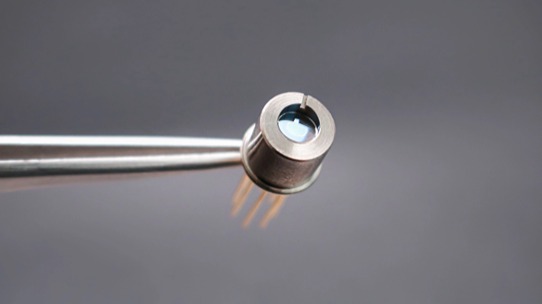
VCSEL (Vertical-Cavity Surface-Emitting Laser) differs significantly from conventional edge-emitting lasers in physical structure. It emits light vertically from the chip surface, delivers a circular and symmetric beam profile, features low threshold current, and supports wafer-level testing.
Thanks to these merits, VCSELs are widely deployed in optical communication, 3D sensing, LiDAR and many other fields. However, accurately measuring optical power and central wavelength before shipment remains a major headache for many R&D and test engineers.
01 Power Testing: Pitfalls in LIV Curves & Special Considerations for Arrays
VCSEL power testing is far more than simply attaching a probe and reading values. The core deliverable is the LIV (Light-Current-Voltage) curve, from which key parameters such as threshold current and slope efficiency can be extracted.
Single-Device Testing Pitfall: Thermal Effects
During continuous-wave (CW) scanning, rising injection current heats the interior of the VCSEL. Once junction temperature climbs, output power saturates and may even suffer thermal rollover.
Mitigation: For high-precision characterization, short-pulse excitation is normally adopted to suppress junction heating, or small current stepping (over 1000 data points per sweep) is used to precisely capture nonlinear behaviour. For high-performance devices, short-term power fluctuation shall be controlled within 0.76% under 2 mA injection; ultra-rigorous precision measurement requires fluctuation between 0.5% ~ 1%.
Challenges for Array Testing: Large Beam Spot & High Optical Power
VCSEL arrays (e.g., large 5 mm × 5 mm chips) have a large emission area and high power output, which cannot be handled by ordinary photodiodes.
Equipment requirements: Integrating spheres or thermopile detectors must be deployed. The integrating sphere input aperture must be sufficiently large (e.g., >25 mm), and the detector shall be placed close to the device (≤10 mm) to ensure full light collection.
Environmental requirements: Water cooling is commonly used during testing, with water temperature stabilised around 21°C. Current must ramp up and down slowly to avoid thermal stress damaging the chip. ESD protection is required before and after operation; terminals shall be shorted to prevent surge.
02 Wavelength Testing: Static Specifications & Dynamic Drift
Wavelength determines whether a VCSEL matches optical communication windows or atomic absorption lines. Testing must evaluate both static spectra and dynamic wavelength drift.
Accurate Static Characterisation
Instrument precision: For narrow-linewidth VCSELs, standard optical spectrum analysers lack sufficient resolution. High-resolution optical spectrum analysers (0.01 nm accuracy class) or scanning Fabry-Perot interferometers are required.
Key metrics: Central wavelength deviation is typically controlled within ±2 nm, and full width at half maximum (FWHM) below 0.5 nm. For single-mode VCSELs, the side-mode suppression ratio (SMSR) is generally required to exceed 30 dB.
Controlling Dynamic Drift
VCSELs are extremely temperature-sensitive. A 1 K rise in junction temperature normally induces approximately 0.06 nm wavelength red shift.
Mitigation: Wavelength testing must run under strict temperature control, or measurements shall be taken at multiple heat sink temperatures to establish the wavelength-temperature coefficient. For tunable VCSELs, the curve of tuning voltage versus wavelength needs plotting to pinpoint mode-hop points.
Industry trend: Today’s monolithic extended-cavity VCSELs can achieve linewidth down to 890 kHz, which pushes traditional spectrometers to their limits and demands higher-resolution measurement techniques.
03 Coupling Effect: Power and Wavelength Cannot Be Measured Separately
In real testing environments, power and wavelength are not independent variables. High injection current generates high power along with heat accumulation, which alters both power and wavelength simultaneously.
If heat sink temperature is not fixed during wavelength measurement, or spectral data is not recorded while measuring power, you cannot decouple electrical injection effects from thermal effects.
Recommended workflow:
Record power and spectral data synchronously at key test points
Use pulsed / continuous-wave comparison method to separate thermal contributions
For highly demanding applications such as quantum sensing, monitor power fluctuation and wavelength drift over long durations at constant current.
Reference Standards:
The domestic baseline standard is GB/T 31359-2015 Test methods for semiconductor lasers. For tunable VCSELs, relevant association standards define more detailed test methods for output power, central wavelength, spectral linewidth and other parameters. All test instruments must stay within valid calibration periods.
04 Three Principles for Test Design
VCSEL power and wavelength testing essentially extracts genuine parameters within a coupled thermal-electro-optical multi-physics field. Keep these three core principles when designing test schemes:
Temperature control comes first; any thermal drift corrupts measurement data.
Select excitation mode (pulsed or CW) according to target parameters.
Observe power and wavelength synchronously; do not prioritize one over the other.
05 Our Testing Services
As an accredited third-party laser testing laboratory, we offer comprehensive VCSEL laser characterisation services:
Full parameter testing: LIV curve extraction, threshold current, slope efficiency, central wavelength, FWHM, SMSR and more.
Advanced test setup: High-precision optical spectrum analysers, integrating spheres and thermopile test systems to support high-power array testing.
Standards compliance: Test reports issued per GB/T 31359-2015 and relevant association standards.
End-to-end service: Custom test scheme design, sample testing and report issuance, all under one roof.