Energy efficiency compliance is a prerequisite for legal product sales across the United States.
Driven by the U.S. manufacturing reshoring policies, the North American industrial motor market is witnessing robust growth. Statistics indicate the North American induction motor market will maintain a compound annual growth rate of over 5%, and its market size will exceed 10 billion US dollars before 2030.
However, energy efficiency compliance is an inevitable threshold for market entry. The U.S. Department of Energy (DOE) and California Energy Commission (CEC) have continuously tightened supervision on motor energy efficiency. Products without valid certifications will be blocked at ports.
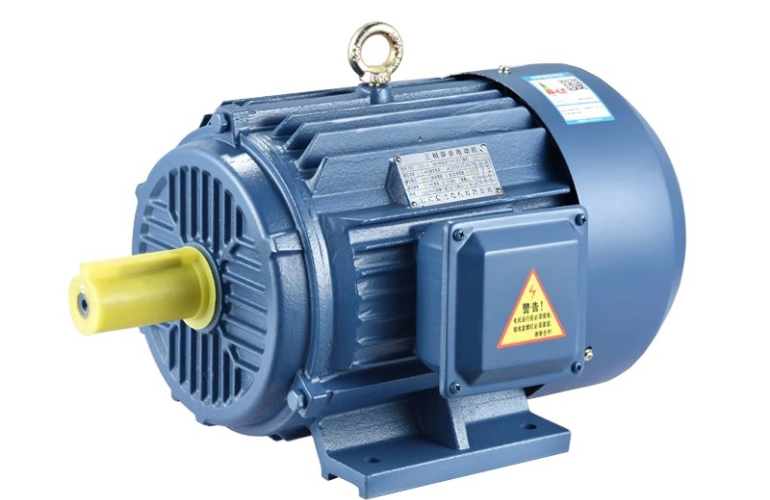
1. Market Opportunities & Compliance Requirements
Three-phase AC induction motors see strong market demand in North America for three main reasons:
- Induction motors are the top choice for more than 65% of new industrial automation projects in the US.
- The booming electric vehicle industry fuels rising demand for supporting motors.
- Large-scale renovation and replacement of aging infrastructure.
Meanwhile, the DOE keeps updating the Minimum Energy Performance Standards (MEPS). Currently, most general-purpose three-phase motors are required to meet IE3 efficiency class, and certain products have moved up to the IE4 standard.
In short: To tap into the U.S. market, your products must first pass energy efficiency compliance checks.
2. DOE vs. CEC Certification: Key Differences
Many manufacturers confuse DOE and CEC certifications. The detailed comparison is as follows:
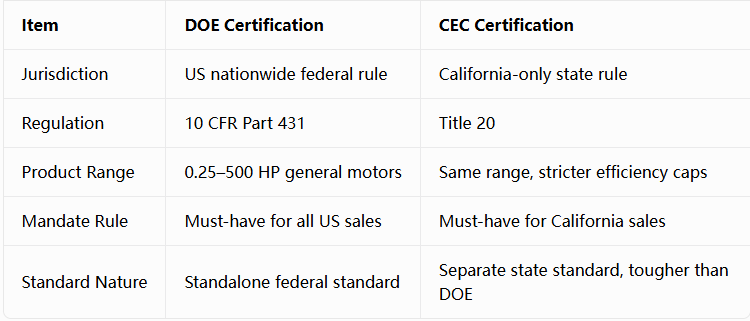
Important Reminder: Products holding DOE certification still cannot be sold in California without CEC listing. Given California’s huge economic scale, CEC compliance is indispensable for U.S. market expansion.
3. Operational Procedures for DOE Certification
DOE certification follows the rule: Testing first, then registration. The whole process includes three steps:
- Confirm Standard ApplicabilityVerify if the motor falls into the category of General-Purpose Motors (Subtype I), and confirm its pole number (2/4/6/8 poles) and power range.
- Sample TestingTests must be conducted by an ISO/IEC 17025 accredited laboratory in accordance with IEEE 112 Method B or IEC 60034-2-1. Key data including full-load efficiency and no-load losses will be collected.
- CCMS RegistrationAfter the standard test report is issued, our team will submit the report and product series information to the DOE Compliance Certification Management System (CCMS). A unique certification number will be generated once the application is approved.
4. Operational Procedures for CEC Certification
The CEC certification process is similar to DOE, with two major distinctions:
- Testing by CEC-Authorized LaboratoriesOnly laboratories officially authorized by CEC are qualified to conduct relevant tests. CEC sets more stringent efficiency limits than federal standards.
- Register for MAEDbS AccountManufacturers need to create an account on the CEC official portal for the Modern Appliance Efficiency Database System (MAEDbS).
- System ListingSubmit test reports and product specifications. The review takes roughly 2 to 5 working days. Once approved, the product status will be marked as Active, which means the listing is completed.
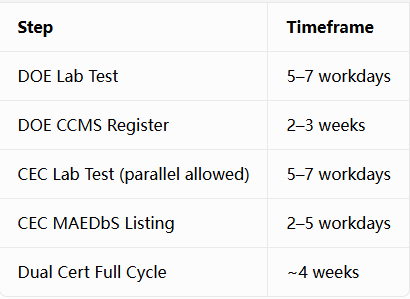
Practical Suggestion: If your products are sold across the US including California, arrange DOE and CEC tests simultaneously to avoid repeated sample delivery.
5. Timeline & Cost Reference
Certification Timeline
Factors Affecting Costs
Certification fees vary based on the following factors:
- Product Complexity: High-power or multi-pole motors (e.g., 8-pole motors) require longer and more complicated tests.
- Rectification Needs: Additional fees will be charged for retesting if the motor fails to meet efficiency requirements (e.g., IE3) in the initial test.
- Single or Dual Certification: Combined application for DOE and CEC is more cost-effective than separate applications.
We provide one-on-one quotation based on motor nameplate parameters, including power rating, pole number and frame size.
6.Our Services
As a professional third-party testing and certification body specializing in motor energy efficiency compliance, we offer comprehensive solutions:
- Possess CMA/CNAS accreditations. Our test reports are fully recognized by the DOE and mainstream e-commerce platforms such as Amazon.
- Full-process one-stop service: Standard confirmation, sample testing, report issuance, CCMS registration, MAEDbS listing and FTC label production.
- Combined DOE & CEC service: One sample delivery for dual certifications to save time and cost.
- Technical support for rectification: Provide professional optimization suggestions if products fail initial efficiency tests, helping you cut extra costs from repeated testing.