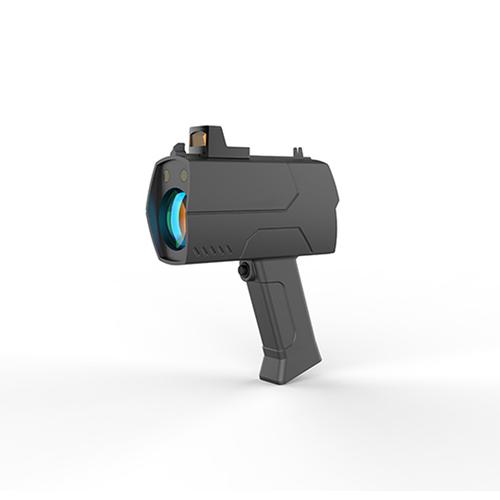
Based on Tunable Diode Laser Absorption Spectroscopy (TDLAS) technology, laser methane detectors feature non-contact measurement, millisecond-level response and strong anti-interference capability. They are widely used in gas inspection, urban pipeline monitoring and coal mine gas early warning applications.
During operation, the device typically emits two laser beams: one invisible near-infrared detection laser (typically around 1653 nm) for methane concentration measurement; the other visible aiming laser to help operators locate the inspection area.
The invisibility of near-infrared lasers creates risks of accidental exposure, as operators cannot visually identify whether the laser is active. IEC 60825-1, the globally recognized standard for safety classification and testing of laser products, serves as a prerequisite technical compliance threshold for laser methane detectors to enter global markets.
01 Standard Framework: Classification Evaluation System
IEC 60825-1 specifies safety requirements for laser products emitting radiation in the wavelength range of 180 nm to 1 mm. Its core is a classification system built upon Accessible Emission Limits (AEL). This standard has been adopted identically as the Chinese national standard GB/T 7247.1-2024, which came into force on April 1, 2025.
The standard categorizes laser products into eight classes: Class 1, 1M, 1C, 2, 2M, 3R, 3B and 4. Higher classes permit greater accessible emission levels and correspond to higher hazard potential.
Two fundamental concepts underpin classification judgment:
Maximum Permissible Exposure (MPE): The level of radiation that the human body can withstand without adverse effects.
Accessible Emission Limit (AEL): The maximum allowable accessible radiation for each laser class, derived from MPE.
For laser products used in measurement applications, the standard sets clear requirements. Invisible laser products generally need to meet Class 1 requirements. While the visible aiming laser may be subject to relaxed criteria, the overall classification of the complete equipment follows the strictest rating among its light sources.
02 Core Test Items
Testing is implemented in three stages: laser parameter measurement, classification assessment and structural verification.
2.1 Laser Radiation Parameter Measurement
This provides raw data for safety classification. In a darkroom environment, accredited laboratories use calibrated spectrometers and power meters to measure the detection laser and aiming laser separately.
Key parameters to be measured:
For continuous-wave laser methane detectors, output power is the most critical parameter for classification. If the device operates in pulsed mode, additional analysis covers pulse duration, repetition rate and peak power density.
2.2 Accessible Emission Assessment & Classification Determination
Measuring the output power of the laser module alone is insufficient. The standard requires assessment of accessible emission, meaning radiation levels that personnel may be exposed to under normal operating conditions and single-fault conditions.
Testing simulates two receiving positions: near-field (e.g. 100 mm) and far-field (e.g. 5 m), since irradiance distribution varies significantly at different distances.
If the measured accessible emission does not exceed the AEL limit for Class 1, the product can be classified as Class 1. If the limit is exceeded, the product will be assigned to a higher class according to the margin of excess.
2.3 Protective Structure Verification
Structural review is often overlooked yet equally critical in laser class testing.
Major inspection items:
Whether the protective enclosure can only be opened with tools. If the housing can be disassembled by hand while the internal laser remains operational, the test is normally deemed a failure.
Whether safety interlocks can reliably cut off laser emission when protective covers are opened.
The sealing and attenuation performance of optical windows meet design specifications.
03 Typical Safety Design Strategies
To achieve Class 1 compliance, coordinated design optimizations are required in optical design, power control and mechanical protection.
Power Control
The power of the detection laser is usually limited below 15 mW, retaining sufficient safety margin while guaranteeing detection sensitivity.
Note: Class 1 does not mean zero laser output. It indicates no hazard will occur under reasonably foreseeable operating conditions.
Differentiated Control for Dual Light Sources
Balanced engineering practice:
Detection laser: Higher power and invisible, strictly controlled, typically Class 1.
Aiming laser: Used for visual positioning. Visible light enables human eye aversion, allowing Class 3R under controlled conditions.
Overall equipment rating: governed by the most stringent light source class.
Structural Protection
Stainless steel or aluminum housings with sealed construction to prevent users from manually accessing internal laser components.
Safety interlocks follow the fail-safe principle: upon failure, the device shall cease operation or remain in a non-hazardous state instead of continuing laser emission.
04 Compliance Significance & Ongoing Management
Market Access
Domestic market: GB/T 7247.1-2024 is the core safety reference for bidding and regulatory inspections of laser methane detectors.
International market: EN 60825-1 for EU markets and FDA 21 CFR 1040.10 for the US adopt comparable classification logic.
Continuous Compliance Management
Work on the 4th edition of IEC 60825-1 is underway, addressing pulse train correction factors and measurement methods for scanning lasers.
EN 60825-1 incorporated Amendment A11 in 2021, introducing extra requirements for consumer laser products, which have not yet been adopted at the IEC level. As a result, the EU standard is no longer fully identical to the international standard.
Exporters need to closely track standard updates for target markets.
Operational Management
Avoid prolonged operation under extreme temperature and humidity.
Prevent drops and strong vibration that may displace optical components.
Clean optical windows periodically to maintain transmittance.