Laser technology plays a vital role in medical treatment, optical communication, industrial manufacturing, consumer electronics and many other fields, yet its inherent hazards cannot be overlooked. To guarantee the safety of laser products, the International Electrotechnical Commission (IEC) has established the unified laser safety standard IEC 60825-1, which categorizes laser products into different risk classes.
Among all classifications, Laser Class 1 is recognized as the safest laser class, ensuring human safety without the need for special protective measures.
1. Overview of the Laser Safety Classification System
Laser safety classes are defined according to the potential hazards to human eyes and skin under normal operating conditions. IEC 60825-1 establishes the following classification system:
Class 1: Safe under reasonably foreseeable operating conditions, including viewing the beam directly through optical instruments.
Class 1M: Safe under specific conditions, yet risks may exist when observed with optical instruments.
Class 2 / 2M (visible light only): Protection is provided by the human blink reflex, but prolonged direct viewing can cause injury.
Class 3R / 3B: Direct exposure poses risks and requires implementation of control measures.
Class 4: High-power lasers capable of causing severe injuries, subject to strict management and control.
This classification framework delivers clear safety guidance for manufacturers, end users and regulatory authorities.
2. Core Definition and Power Criteria of Laser Class 1
A Class 1 laser product is defined such that, under all manufacturer-specified operation, maintenance and servicing conditions and for any emission duration, the accessible emission level (AEL) of laser radiation remains below the maximum permissible exposure (MPE) for the corresponding wavelength and exposure duration.
This means direct viewing within the beam path or skin exposure to a Class 1 laser product will not result in biological tissue damage.
In terms of power specifications, the AEL for Class 1 varies depending on laser wavelength and operating mode (continuous wave or pulsed). For example:
For conventional visible continuous-wave lasers (400 nm to 700 nm wavelength), the Class 1 AEL is typically 0.39 mW.
For pulsed lasers, the AEL is calculated based on pulse duration and repetition frequency to ensure total energy stays below the damage threshold.
These stringent limits ensure Class 1 products will not exceed safe radiation levels even under fault conditions.
3. Typical Applications of Class 1 Laser Products
Thanks to their inherent safety, Class 1 lasers are widely adopted in sectors with strict end-user safety requirements:
Consumer electronics: Laser printers, optical disc drives, barcode scanners
Medical equipment: Flow cytometers, blood cell analyzers, certain diagnostic imaging devices
Industrial and laboratory instruments: Collimators, interferometers, selected laser rangefinders
Information and communication technology: Enclosed laser modules for fiber-optic communication systems
Entertainment and display: Selected holographic displays and low-power laser demonstration equipment
In such applications, the laser source is usually fully enclosed, or the design guarantees output power permanently stays below Class 1 limits.
4. Certification Procedure for Class 1 Lasers
Obtaining Class 1 classification requires rigorous assessment:
Hazard Analysis: Manufacturers must identify all potential radiation sources, including primary beams, scattered and reflected light.
Engineering Control Design: Use physical enclosures, safety interlocks, optical attenuators and other measures to ensure accessible emission remains below the AEL.
Testing and Measurement: Authorized laboratories measure radiation levels following standardized procedures covering all operating modes.
Documentation Preparation: Compile technical files including design drawings, test reports, risk assessments and user instructions.
Declaration of Conformity: Manufacturers or certification bodies issue an official statement of compliance, and products are marked with Class 1 laser labels.
Certification is generally performed against IEC 60825-1 or equivalent national standards such as US FDA 21 CFR Part 1040.
5. Protection Requirements for Class 1 Lasers
The core safety philosophy of Class 1 products relies on inherent safety achieved through engineering design rather than user compliance. Primary protection requirements are listed below:
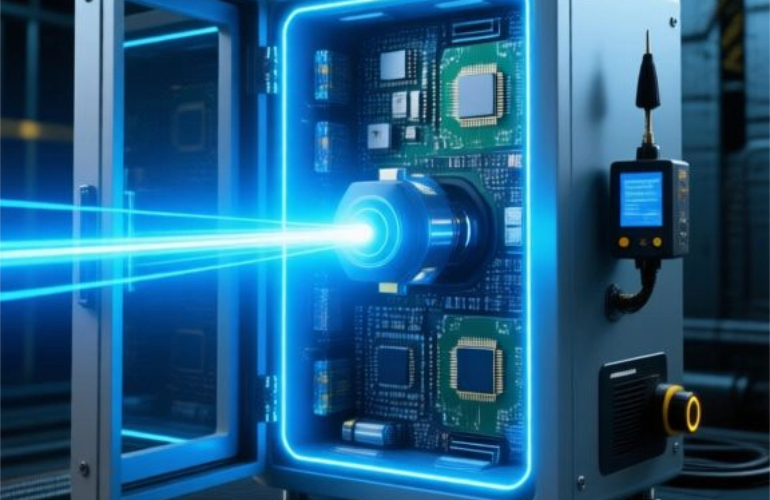
Full Enclosure: The laser operates inside protective housing, and radiation from all accessible surfaces is kept under Class 1 limits.
Fail-Safe Design: The system maintains a safe state even if a single fault occurs, commonly realized via redundant safety circuits.
Warning Markings: Although personal protective equipment is not mandatory, laser hazard symbols and the marking “Class 1 Laser Product” must be affixed.
User Guidance: Provide clear operation and maintenance instructions to prevent unauthorized modification that may introduce risks.
It is worth noting that Class 1 does not require operators to wear laser safety eyewear, as radiation hazards have been eliminated at the design stage.
6. Key Significance of Class 1 Laser Certification
End User Safety Assurance
Class 1 certification delivers the highest level of laser safety protection for end users, especially ordinary consumers and medical patients without professional safety training.
Regulatory Compliance and Global Market Access
Many countries mandate safety class marking for laser products. Class 1 certification facilitates compliance with major global regulatory frameworks including EU CE marking, US FDA requirements and China GB standards.
Product Reliability and Brand Reputation
The strict certification process drives robust product design reliability and enhances brand credibility and user trust.
Mitigation of Liability Risks
Independently verified Class 1 products substantially reduce legal and liability risks arising from laser-related injuries.
Promotion of Technological Innovation and Popularization
By encapsulating high-risk laser sources into safe Class 1 products, advanced laser technology can be safely integrated into daily life and diverse industries.
Class 1 laser represents the gold standard for laser safety design. Rigorous engineering controls reduce potential hazards to a negligible level. Amid the widespread adoption of laser technology, Class 1 certification is not merely a regulatory obligation, but also demonstrates manufacturers’ commitment to end-user safety.
As technology evolves, future Class 1 products will achieve safe operation across an expanded range of power and wavelength bands, continuously supporting innovation within a safe laser application framework.
For consumers, selecting products marked Class 1 means choosing reliable and worry-safe laser equipment.